





How to Make Pre-Rolls & Scale Production
Posted by Cones Canada on Jul 20th 2026
Pre-rolls are the most popular cannabis category in Canada and any LP that does not have a pre-roll line on dispensary shelves is leaving money on the table.
In 2025 alone, pre-rolls accounted for $1.4 billion revenue – a 33.9% market share – and 77.2 million units sold, more than any other category, according to cannabis analytics firm Headset.
That's too big a market and too big a category to ignore.
But getting from cured flower to a finished, compliant pre-roll ready for sale under the Cannabis Act is a more involved process than it looks from the outside. Every step, from grinding to final packaging, affects the quality of what ends up in the customer's hand, and in Canada's tightly regulated market, it also affects whether that product clears Health Canada's requirements in the first place.
So how do you make pre-rolls that keep customers loyal to your brand?
Fear not, the Pre-Roll Experts are here with a practical, step-by-step look at how pre-rolls are made and scaled for production, designed for LPs in the Canadian cannabis industry.

How to Make a Pre-Roll Part 1: Grinding and Sifting
We like to say it all starts with the grind.
You worked hard growing your flower, making sure it was taken care of and developed exactly the right terpene and cannabinoid profile. That's what makes a good pre-roll.
And that's why choosing the right grinder is so important.
Grinding your flower is absolutely necessary for packing up pre-rolls, of course, but HOW you choose to do that can have drastic effects on your final product. The wrong grinder can destroy those cannabinoids and terpenes.
The most important thing to look for in a grinder is one with low RPMs. High-RPM grinders, like a blender or food-processor-style equipment sometimes used by smaller operators generate heat through blade speed and friction. Whip-style grinders and shredders also operate at high RPMs and generate heat.
That heat is what degrades the cannabinoids and terpenes.


A high-RPM grinder like a shredder also does not produce a consistent particle size, which will become important down the line when packing your pre-rolled cones, and sometimes has a tendency to reduce your flower to hot-burning dust.
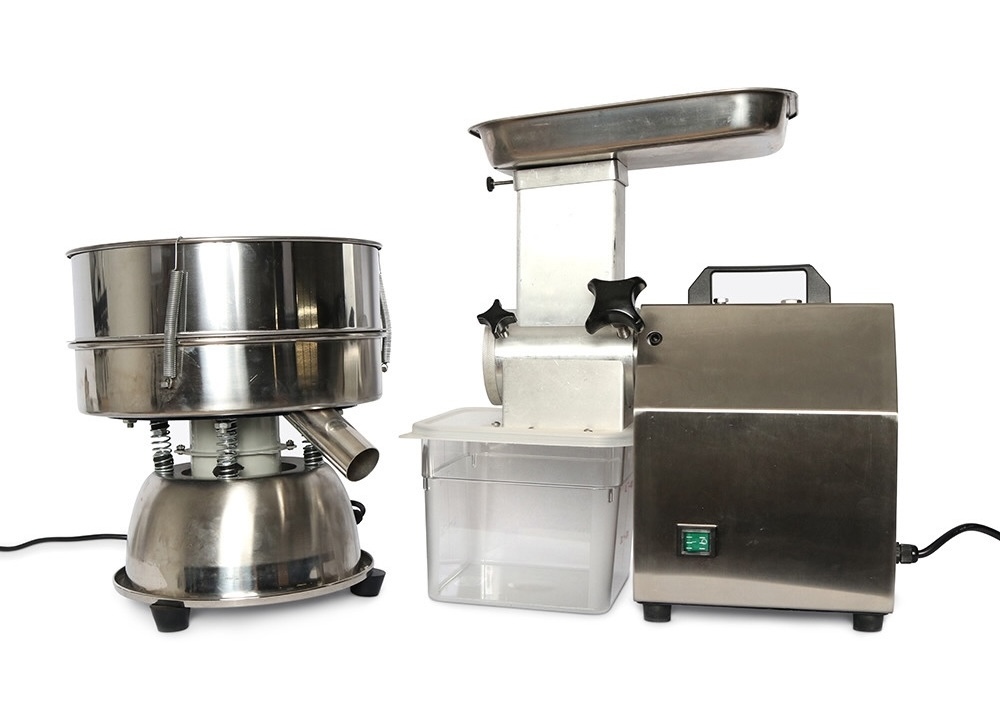
Instead, look for a low-RPM, high-torque grinder with interchangeable screens, such as the Industrial Cannabis Grinder, which produces a far more consistent result while preserving cannabinoids and terpenes. The Industrial Cannabis Grinder uses its high-torque motor to push the flower through an interchangeable screen to create a consistent particle size that is fluffier and richer in cannabinoids and terpenes than a shredder or whip-style grinder.
Made of stainless steel, the industrial cannabis grinder can process hundreds of pounds per day and can easily be taken apart and cleaned. Plus, the multiple screens allow you to truly dial in the right grind for your flower, which we all know varies so greatly from strain to strain.
After the grind comes sifting, an often-overlooked step that can help prevent headaches down the line: sifting.
Sifting creates a uniform particle distribution from your ground material, as well as removes any stem fragments that could tear your pre-rolled cones during packing. Care needs to be taken in making sure you don't over-sift and separate the trichomes (kief) from the flower, but sifting is a vital step that pays dividends in the long run. (That being said, if you wanted to make kief or hash, dry sifting is a way to get that done and our automated cannabis sifters are perfect for scaling your production.)
In short, sifting is about quality control. An industrial sifter helps keep the pack even, removes stems and helps remove large particles, which can ruin the smoking experience by creating hot spots in a burning pre-roll.
Pre-Roll Pro Tip
1 - After grinding and sifting your flower, it is a good idea to allow the bud to dry/cure again. The grinding process is going to agitate the trichomes and cause the flower material to be extra sticky, which can complicate the packing process and gum up the machinery. Instead, grind ahead of time and give the material oils in the material time to get settled.
2 - Collect the kief separated during the sifting process and mix back with your flower. Particles tend to settle over time, so products should be mixed if stored for future production.
How to Make a Pre-Roll Part 2: Packing Your Pre-Roll
With your flower ground and sifted, it's time to begin the packing process. Begin, of course, by choosing your pre-rolled cones.
The most popular single size is the 109mm full-gram pre-rolled cone, but the 84mm half-gram pre-rolled cone is perhaps the most versatile, with consumers more and more often reaching for multi-packs, such as 1-gram 2-packs and 2.5-gram 5-packs. The 70mm mini "dogwalker" pre-rolled cone is also a very popular option, especially for multi-packs.
Once you've chosen a size, pick a paper type. Refined white and natural brown are the most popular papers, but some brands use 100% organic hemp paper to help their products stand out. Others will use hemp wraps or hybrid hemp wraps to make pre-rolled blunts.
But don't feel locked into a single paper or cone size. In fact, the biggest, most successful pre-roll brands use multiple sizes and multiple paper types, depending on the specific pre-roll product.
For now, let's talk packing.


Cone-Packing Machines
The key to making a high-quality pre-roll is a calculated, consistent pack. A pre-roll that has air pockets or gaps in it will form hot spots and potentially canoe down one side, and a pre-roll that is packed too tight either won't stay lit or won't draw during consumption.
This is one of the reasons it's so important to make sure you grind and sift, as consistent particle size helps alleviate both of those issues.
A good, high-quality pre-roll begins with a solid foundation along the filter, with the density gently loosening through the top of the cone. This can be done by hand using a bouncing motion or with an electronic cone-filling machine.
There are three main machine methods for filling cones: bounce, vibration and spin. All will work to create consistent, high-quality pre-rolls, so it really comes down to a matter of preference in machine and style.
A vibration motor is the most common method for creating a consistent pack. Machines like the Fill N' Fold and the KnockBox use vibration motors to shake the cones as they are being filled, evenly distributing the flower through the cone. However, the machines themselves are different. The Fill N' Fold, for example, is a more versatile machine, with interchangeable work trays, volumetric metering trays and a tamping/closing tool that vastly reduces time spent on the back end of production. It is also not made of glass, which means it can be used to safely fill pre-rolled cones that have premium filter tips, allowing for an expanded product line.
The King Kone cone packing machine, on the other hand, uses a vertical bounce motor, not vibration. An incredibly versatile machine that uses a system of varying work trays to fill cones of any size, the King Kone's motor is adjustable, allowing for differing packs with differing flower, and the vertical bounce helps bring denser particles to the filter. The King Kone also comes with myriad accessories like metering trays and even a separate King Kone Closer device that with an extra step can close a full run of cones with a single pull of a handle.
For larger producers, or producers looking for something a little different, there is the Hummingbird PR-1, which uses a centrifugal motor to spin the flower inside the cones, creating an almost perfect density gradient with the slightly denser pack at the bottom for structure and a looser pack at the top for more airflow during the initial lighting phase. The Hummingbird is a little bigger and more expensive, but it also has metering trays available and makes quick work of filling cones.
All three machines are tabletop cone-filling machines and all three methods of packing can produce high-quality pre-rolls. It really is a matter of choice: which machine works best for your space, your employees and your budget?
For larger LPs producing at least 10,000 pre-rolls per month, consider an automated filling machine.
The Holes Fallacy
Many people will decide which pre-roll machine to buy based solely on the capacity of pre-rolls it can pack per cycle. But simply packing a large number of cones at once does mean that said machine will help produce the most completed pre-rolls during a shift.
We call this The Holes Fallacy. In the most basic terms, it means that pre-rolls packed per cycle does not translate to a finished product. This is because there are other factors at work, including employee training, metering and especially closing.
For example, we ran a Battle of the Pre-Roll Machines experiment to test the Holes fallacy and found that the machine with the most slots for cones got beat by the machine that, at the time, had the easiest closing method.
Loading cones and closing filled pre-rolls are the two most consistent time-taking complaints we hear from producers. And thankfully, cone-filling machine manufacturers have begun to address them. For example, the Fill N' Fold won our original Battle because the included folding/tamping toll allows operators to close up to 11 pre-rolls at a time, vastly speeding up the back end. Since then, King Kone has introduced a Closer Device that with a few additional steps will close a full tray of 169 pre-rolls at a time.
Additionally, Fill N' Fold introduced a cone-loading device that allows users to load full stacks of cones and drop up to a full run of 121 at a time, saving time and the monotony of loading each empty cone by hand.
Contact the Pre-Roll Experts today to discuss which pre-roll machine will work best for YOUR facility and brand.
How to Make a Pre-Roll Part 3: Closing Your Pre-Roll
The final step of the process – before packaging, of course – is closing your pre-rolls. There are two main ways of doing this: the twist and the Dutch Crown-style fold.
A twist close is by far the simplest way to finish your pre-rolls. Employees simply remove the filled pre-roll from the machine, gather the paper left at the top between their fingers and give it a twist, closing in the flower and giving consumers a wick to light.
It's fast, it's easy and it works.
But a twist doesn't always create the most professional-looking pre-rolls and beyond that, twisting the paper can cause an uneven burn right after lighting, which can lead to twisted pre-rolls having a tendency to canoe more than folded ones.
A true Dutch Crown creates a small crater at the very top of your pre-roll. The paper is folded in to hold in the flower, but it is done so in a way that leaves a little sticking up like, well, a crown. It looks spectacular and burns great, but it is a little trickier at scale.
That's why so many pre-roll producers use a Dutch Crown-style fold, using a tool of some sort to fold over the extra paper at the top, but folding it flat instead of leaving the crown. It creates a smooth, professional finish and because the paper is not twisted, it is less likely to send your fire down one side of the pre-roll than a twist-top, making for a better experience.
For manufacturers making pre-rolled blunts, either with pre-rolled blunt cones or pre-rolled blunt tubes, folding can be a little trickier and often requires additional moisture added, usually with a hand-held steamer or similar device. For those LPs, we recommend considering silicone caps that can just be placed over the end of a filled pre-roll blunt, preserving the hemp wrap.
Final Inspection
Before you package your product, it is crucial to give it a final, thorough look. Not only do you want to make sure everything looks right, but you also want to make sure it meets Health Canada compliance regulations. Because after spending all that time, the last thing you want to happen is for your customers to get a damaged product or for the shops not to be able to sell the pre-rolls because they are not compliant with the law.
The first thing you want to do is weigh your pre-rolls to make sure they are accurate. Health Canada regulations allow a variance of up to 10% on pre-rolls weighing up to 2 grams and a 5% variance on pre-rolls weighing more than 2 grams. This means that a 1-gram pre-roll, for example, must weigh between 0.9-1.1 grams to be in compliance.
Remember, of course, to tare your scale with an empty cone before weighing.
Next, examine the quality of the pre-roll. For example, there are a few things that can cause the paper to tear on the outside of the pre-roll during packing. A stem could've found its way into the cone, or the cone might have been too tightly packed/tamped. Maybe the cone is just falling apart, wasn't closed properly or has an uneven gum line. Some of these problems can be fixed, but some just need to be reworked.
A great pre-roll should look clean and feel like a ripe tomato when you lightly squeeze it: there should be little give, but it should spring right back into place. That means the flower is perfect, the pre-roll has been beautifully packed and it will produce a wonderful smoking experience for your customers.
Final Steps & Thoughts
And there you have it, a fully-packed and closed high-quality pre-roll. The only thing left is to package your pre-rolls and get them to market.
Which is a subject for a different day, though whatever pre-roll packaging you choose – from plastic doob tubes to glass tubes to tins, boxes and everything in between – remember that Health Canada regulations require all pre-rolls to be packaged in child-resistant packaging with a tamper-evident band, so take that into consideration.
Also remember that your pre-rolls must be tested in their final form, which includes the paper. That's why it's so important to choose a pre-roll supplier that tests all of their products to the same high standards that Health Canada requires for flower for pesticides, microbials and heavy metals, like Cones Canada does. Because the last thing you need is for all your work to have to be destroyed due to dirty paper.
Finally, consumers consistently tell us that brand is the number 3 factor when choosing a pre-roll to buy (behind potency and price), so consider custom labels and branding to ensure that your brand and messaging stands out and everyone knows exactly where the high-quality pre-roll they are smoking came from.
Now let's get packing.
Let's take a step-by-step look at how pre-rolls are made and scaled for production, designed for LPs in the Canadian cannabis industry.